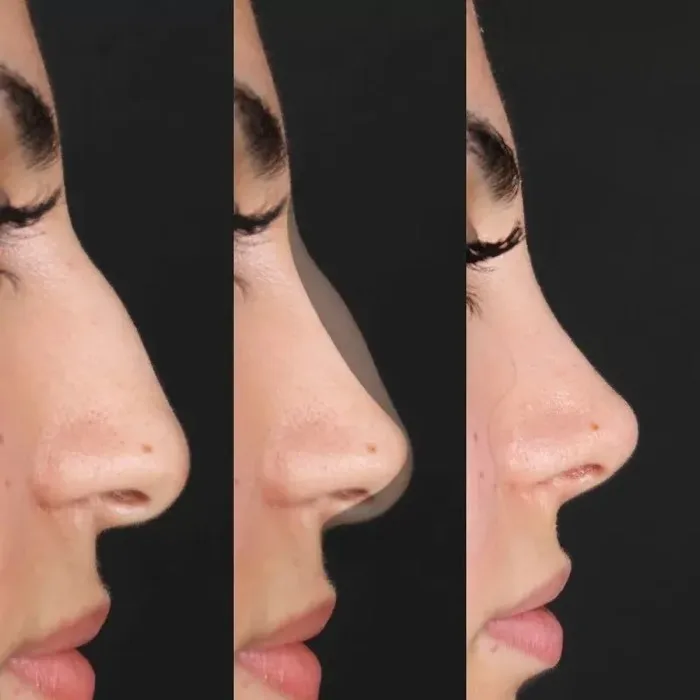

The essential difference lies in where the incision is made and how far the integrity of the soft tissue is preserved.
The essential difference between closed rhinoplasty and the open technique lies in the anatomical region where the surgical incision is made, and in how far the integrity of the soft tissue is preserved. In closed rhinoplasty every incision is made inside the nostrils; no scar remains on the outside, and because the vascular, nerve and lymphatic network of the nasal skin is preserved, swelling and bruising are far less pronounced. In open rhinoplasty an external incision is made across the central column dividing the nostrils (the columella) and the nasal skin is lifted completely; this gives the surgeon broad, direct vision but lengthens both recovery and the return of sensation.
1. Incisions and Scarring: The Role of the Columellar Incision
- Closed rhinoplasty (scar-free surgery): All incisions are made within the nasal mucosa. No externally visible incision or scar forms on the tip or the nostril rims.
- Open rhinoplasty (external incision): An external incision, in an inverted "V" or stepped shape, is made in the bridge of skin between the two nostrils (the columella). It is closed with sutures and leaves a fine surgical scar.
2. Tissue Integrity, Swelling and Bruising
- Lymphatic and vascular circulation: In the closed technique the skin of the dorsum and tip is not fully separated from the framework, so the micro-vessels that nourish the skin and the lymphatic channels that drain swelling are preserved. Post-operative swelling and bruising under the eyes are therefore markedly less than with the open technique.
- Tissue separation: In the open technique the nasal skin is lifted entirely away from the bone and cartilage framework. Because circulation through the tissue is temporarily interrupted, swelling tends to persist for longer after surgery.
3. Recovery Time and Sensation in the Nasal Tip
- A quicker return to social life: Because the integrity of the subcutaneous soft tissue and lymphatic drainage is preserved, patients who have closed rhinoplasty can generally return to work and social life within 7 to 10 days. With open rhinoplasty this can take 14 to 21 days.
- A dynamic tip and preserved sensation: In closed surgery the natural cartilage ligaments of the tip (the Pitanguy and scroll ligaments) are kept intact. There is therefore no risk of lasting stiffness or loss of sensation at the tip; the nose moves flexibly and naturally with facial expression. In the open technique, because nerve endings at the tip are divided, numbness can persist for up to six months.
Which Technique Suits Which Patient?
In deciding, the patient's cartilage structure, skin thickness and previous surgical history are all assessed:
Suitable candidates for closed rhinoplasty: patients undergoing surgery for the first time (primary cases), those with a dorsal hump or deviation, those who wish to refine or raise the tip, and anyone who does not want an external scar. In modern practice, the closed technique combined with piezo ultrasonic surgery yields tissue-friendly results in rhinoplasty in İzmir.
Suitable candidates for open rhinoplasty: cases following serious facial trauma, patients with advanced cleft lip and nose anomalies, or complex revision cases in which the nasal framework has collapsed entirely and large graft blocks must be placed from the rib.
Frequently Asked Questions
Can any nose be reshaped with closed rhinoplasty?
Yes. With contemporary surgical instruments and microsurgical techniques, rasping of a hump, cartilage shaping, narrowing of the tip and correction of deviation can all be carried out safely with the closed technique.
How does the surgeon see the nose during closed rhinoplasty?
The surgeon works through the nostrils using special intranasal retractors, illuminated micro-instruments and endoscopic viewing systems, which give full command of the bone and cartilage anatomy.
Does the open rhinoplasty scar fade completely with time?
With good suture technique the columellar incision fades over time, but depending on skin tone and texture it may still be discernible as a faint line at close range. With the closed technique there is no external incision, so this risk does not arise.