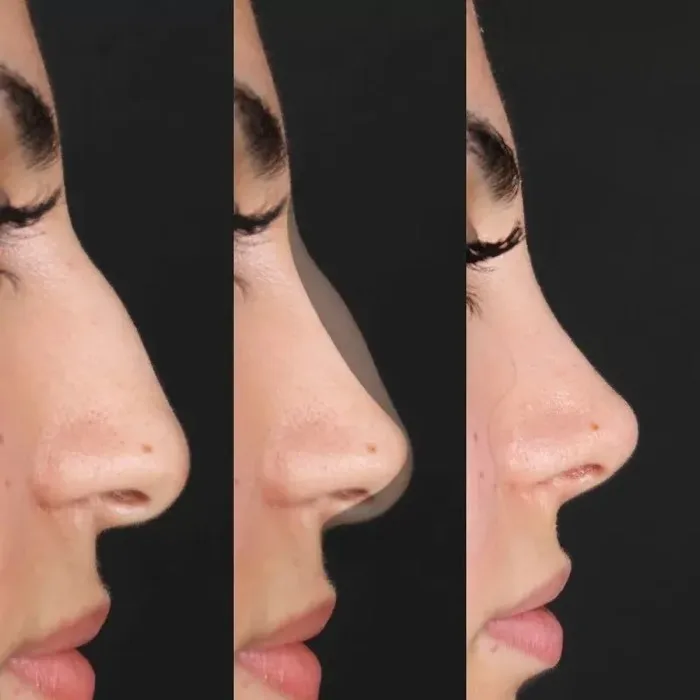

How many days do swelling and bruising last after rhinoplasty? The stages of nasal swelling, week by week.
Bruising after rhinoplasty usually turns yellow and disappears completely between the seventh and tenth day after surgery; roughly 70–80% of the main surgical swelling around the eyes and the nasal dorsum settles within the first month. The remaining fine swelling resolves, and the tip of the nose takes its final anatomical form, over 6 to 12 months in thin-skinned noses and 1 to 2 years in thick-skinned ones. Tissue-preserving closed rhinoplasty and ultrasonic piezo surgery markedly reduce bruising and swelling, and so shorten this process.
A Week-by-Week and Month-by-Month Timeline
The inflammatory response of nasal tissue to surgery recedes in distinct biological stages:
Days 1–3 (the peak): Swelling and bruising are at their most pronounced. Mild puffiness under the eyes and across the cheeks is normal. Keeping the head elevated at 45 degrees and applying cold compresses regularly for the first 48 hours limits the swelling.
Days 7–10 (bruising fades): The thermoplastic splint and silicone splints are removed. Bruising around the eyes turns from blue and purple to yellow and green and largely clears; patients can comfortably return to social life.
Month 1 (about 70% healed): Most of the coarse swelling on the nasal dorsum resolves. From the outside the nose no longer looks operated on, though the tip may still feel firm and numb.
Months 3–6 (80–90% healed): The contours of the nose, the bony curves and the line of the dorsum become defined. The slight tissue swelling present on waking subsides quickly during the day.
Year 1 and beyond (final form): The skin of the nasal tip thins, micro-swelling clears entirely, and the true contour of the cartilage framework settles fully into place.
Six Effective Rules That Speed the Resolution of Swelling
Sleeping with the head raised: For the first 3–4 weeks, sleeping on your back with at least two pillows (a 30–45 degree incline) uses gravity to aid venous drainage and prevents morning swelling.
Limiting sodium (salt): Heavily salted, processed and brined foods make the body retain water and increase lymphatic swelling in the nasal tissue.
Plenty of water and a diet that reduces swelling: Drink at least 2.5–3 litres of water a day, and favour foods that support natural lymphatic circulation, such as pineapple (for its bromelain), green tea and parsley.
Avoiding hot environments: For the first six weeks, stay away from saunas, steam baths, solariums, hot hairdryers and very hot showers; heat dilates the vessels and triggers swelling.
Pausing the use of spectacles: For the first 6–8 weeks, until the nasal bones have knitted, heavy or metal-framed glasses should not be worn; the pressure can make the swelling settle asymmetrically.
Nasal massage under medical supervision: From the third week, the lymphatic drainage massage recommended by your surgeon speeds the clearance of swelling from the nasal dorsum.
Frequently Asked Questions
Is it normal for my nose to look more swollen in the morning?
Yes. Lying flat overnight allows fluid to collect in the face under the effect of gravity. As you stand and move through the day, that swelling drains downwards.
Why is the tip of the nose the last to settle?
The tip is the anatomical region where lymphatic fluid gathers last under gravity, and where the subcutaneous fat over the cartilage is thickest. For this reason the dorsum may thin within 2–3 months while the tip can take up to a year to soften.
How does smoking affect bruising and swelling?
Nicotine narrows the capillaries and impairs oxygen supply to the tissue in the surgical field. In patients who smoke, bruising takes longer to fade, swelling persists, and the risk of subcutaneous scar tissue increases.