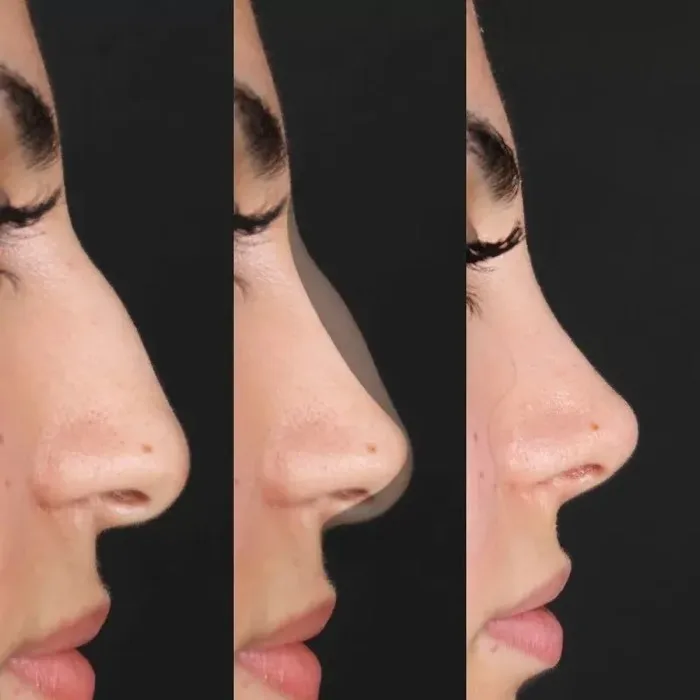
Revision Rhinoplasty, also known as revision nose aesthetics, is a secondary nose surgery performed for patients who have previously undergone rhinoplasty but are not satisfied with the results or experience functional problems with their nose.
Failure to achieve the expected results from the first surgery, persistence of functional problems, or deformities that develop over time may necessitate revision surgery. Since this operation is more complex and technically challenging than standard rhinoplasty, it is of great importance that it is performed by an experienced specialist in the field.
What Is Revision Rhinoplasty?
Revision rhinoplasty is a Secondary Nose Aesthetics operation performed for patients who have previously undergone nose aesthetics surgery but are not satisfied with the results or experience problems with nasal functions. Failure to achieve the expected outcomes from the first surgery, continuation of functional problems, or deformities that appear over time may make revision surgery necessary. As this operation is more complex and technically demanding than standard rhinoplasty, it is crucial that it is performed by an experienced specialist.
Why Is Revision Rhinoplasty Necessary?
The need for Revision Nose Aesthetics Surgery may arise due to various reasons. One of the main reasons is the inability to fully correct the fundamental structural problems of the nose during the first surgery or unexpected healing of the nasal tissue. In some patients, excessive tissue removal during the first operation may lead to weakening of the nasal structure and related deformities. Other common reasons include drooping of the nasal tip, irregularities on the nasal dorsum, asymmetry, difficulty breathing, and excessive resection of nasal cartilage.
Many patients who are not satisfied with the results of the first surgery may experience breathing difficulties in addition to residual structural problems in the nose. Especially in cases of damage to the internal nasal valves, deviation of the septum (midline), or hypertrophy of the turbinates (nasal conchae), aesthetic and functional problems may coexist.
It is extremely important for patients to have realistic expectations before revision surgery. Scar tissue and structural changes that occur after the first surgery make revision surgery more complex. Therefore, before deciding on revision rhinoplasty, at least 12 months should pass after the first surgery and complete tissue healing should be awaited.
At our clinic, a detailed evaluation process is applied for revision rhinoplasty candidates. The patient’s previous surgical records are reviewed, current complaints and expectations are listened to, and the internal and external structure of the nose is carefully evaluated. As a result of this comprehensive analysis, a personalized treatment plan is created and the patient is informed about possible outcomes.
Revision Rhinoplasty Surgical Techniques
During Revision Nose Aesthetics, the use of grafts may be required. Grafts are tissue pieces used to strengthen and support weakened or missing nasal structures. Ideally, cartilage tissue taken from the patient’s own body is preferred. These include ear cartilage, rib cartilage, or septal cartilage (if remaining portions are available).
During surgery, scar tissue formed from the previous operation is carefully removed and the nasal framework is reconstructed. Shaping of the nasal tip, correction of nasal deviations, and widening of the airway are important steps of this operation. The precise techniques applied in our clinic aim to achieve optimal aesthetic and functional results while minimizing tissue damage.
The “Structural Rhinoplasty” approach we prefer in revision surgeries focuses on strengthening the nasal framework. In this technique, instead of weakening the nasal structure, long-term permanent and natural results are achieved by supporting the cartilage and bone structures. During surgery, nasal tip support, lateral valve insufficiency, and other breathing problems are also addressed.
Recovery Process After Revision Rhinoplasty
The recovery process after Revision Rhinoplasty generally takes longer and requires more care compared to the first rhinoplasty surgery. Postoperative edema and swelling may be more pronounced due to scar tissue remaining from the previous surgery and may take longer to subside.
After surgery, a nasal splint is usually placed and remains in place for 7–10 days. In our clinic, to increase patient comfort, nasal packing is not placed inside the nose; instead, perforated silicone splints are used. Thanks to this, patients can breathe comfortably even immediately after surgery. These splints are usually removed 2–4 days after the operation.
A significant reduction in swelling and bruising is observed within the first week. However, it takes longer for the nose to achieve its final shape. The complete healing process after revision rhinoplasty may take 12–18 months depending on the patient’s tissue structure, the complexity of the procedure performed, and the effects of the previous surgery. During this period, the healing process is closely monitored through regular follow-up appointments.
It is important for patients to follow certain restrictions during the recovery process. Heavy physical activities and sports should be avoided for at least 3–4 weeks, and sun exposure should be limited for at least 3 months. Additionally, some restrictions regarding the use of glasses may be necessary.
Unlike the first rhinoplasty, the permanence of the results after revision rhinoplasty depends not only on the surgeon’s skill but also on the existing tissue damage and the amount of scar tissue. Therefore, it is important for patients to have realistic expectations and to be patient during the recovery process.
As Dr. İbrahim Korhan and his team, with our many years of experience in revision rhinoplasty surgery, we provide personalized solutions tailored to the unique needs of each patient. Our goal is to ensure that our patients achieve a problem-free nose with which they are satisfied in every aspect.
After completing my residency at the Department of Otorhinolaryngology at Ege University Faculty of Medicine, I have been providing services in my own private clinic since 2020, following the experience I gained in public and private healthcare institutions.